The Ultimate Guide to Mastering SEO Content Writing
In today’s crowded digital landscape, simply having a website isn’t enough. To attract organic traffic and stand out from the competition, you need to create content that not only resonates with your audience but also speaks the language of search engines. This is where SEO content writing comes into play. Effective SEO content writing is the cornerstone of any successful digital marketing strategy, ensuring your valuable information is discovered by those actively searching for it. This comprehensive guide will delve deep into the art and science of SEO content writing, equipping you with the knowledge and tools to significantly improve your search engine rankings.
What is SEO Content Writing?
At its core, SEO content writing is the process of creating and optimizing content for search engines to understand and rank, while simultaneously providing value and engagement to human readers. It’s a delicate balance between technical optimization and compelling storytelling. The goal is to attract, inform, and convert visitors by appearing prominently in search engine results pages (SERPs) for relevant queries. This means going beyond just stuffing keywords; it involves a strategic approach to topics, structure, and readability.
Why is SEO Content Writing Crucial?
The importance of SEO content writing cannot be overstated. Consider these key benefits:
- Increased Organic Traffic: High-ranking content draws in a consistent stream of users actively seeking solutions or information related to your offerings.
- Improved Brand Authority and Trust: Consistently delivering high-quality, informative content positions your brand as a thought leader in your niche, fostering trust with your audience.
- Higher Conversion Rates: When users find the exact information they’re looking for on your site, they are more likely to take desired actions, such as making a purchase or signing up for a newsletter.
- Cost-Effectiveness: Compared to paid advertising, organic traffic from SEO is a more sustainable and cost-effective long-term strategy.
- Enhanced User Experience: Good SEO content writing naturally leads to better-structured, more readable content, which improves the overall user experience on your website.
The Pillars of Effective SEO Content Writing
Mastering SEO content writing involves a multifaceted approach. Let’s break down the essential components:
1. Keyword Research: The Foundation of Your Strategy
Keyword research is the bedrock upon which all effective SEO content writing is built. It involves identifying the terms and phrases your target audience uses when searching for information, products, or services related to your business. Without understanding what people are searching for, your content will likely miss the mark.
Understanding Search Intent
It’s not enough to simply find high-volume keywords. You must also understand the intent behind those searches. There are generally four types of search intent:
- Navigational: Users looking for a specific website (e.g., “Facebook login”).
- Informational: Users seeking answers to questions (e.g., “how to tie a tie”). This is where most SEO content writing shines.
- Commercial Investigation: Users researching products or services before making a purchase (e.g., “best running shoes”).
- Transactional: Users ready to make a purchase (e.g., “buy iPhone 15”).
Your SEO content writing should align with the predominant search intent for your target keywords. For instance, if you offer services, informational and commercial investigation keywords are prime targets. For e-commerce, transactional and commercial investigation keywords are key.
Tools for Keyword Research
Several powerful tools can aid in your keyword research:
- Google Keyword Planner: A free tool that provides keyword ideas and search volume data.
- SEMrush: A comprehensive suite offering keyword research, competitor analysis, and more. Learn more about SEMrush.
- Ahrefs: Another industry-leading tool for in-depth keyword analysis, content gap identification, and backlink research. Explore Ahrefs capabilities.
- Google Search Console: Offers insights into the queries users are already using to find your site.
Long-Tail Keywords
Don’t overlook the power of long-tail keywords. These are longer, more specific phrases (typically three words or more) that have lower search volume but higher conversion rates because they indicate a more precise user intent. For example, instead of “shoes,” consider “waterproof trail running shoes for women size 8.” These are goldmines for targeted SEO content writing.
2. On-Page Optimization: Making Your Content Search Engine Friendly
Once you’ve identified your target keywords, the next step in effective SEO content writing is on-page optimization. This involves strategically incorporating your keywords and optimizing various elements on your web page to signal relevance to search engines.
Title Tags and Meta Descriptions
Your title tag is the clickable headline that appears in SERPs. It should be compelling, accurately describe the content, and include your primary keyword, ideally near the beginning. Aim for a length of 50-60 characters.
The meta description is the snippet of text below the title tag. While not a direct ranking factor, it acts as a mini-advertisement for your page, encouraging users to click. It should be concise (around 150-160 characters), engaging, and include your main keyword.
Header Tags (H1-H6)
Header tags are crucial for structuring your content and making it scannable for both users and search engines. Your H1 should be the main title of your page, containing your primary keyword. Subsequent headers (H2, H3, etc.) should break down the content into logical sections, using related keywords and subtopics. This hierarchical structure is a key aspect of good SEO content writing.
URL Structure
Keep your URLs short, descriptive, and keyword-rich. Avoid lengthy strings of numbers or irrelevant characters. For example, `yourwebsite.com/seo-content-writing-guide` is far better than `yourwebsite.com/page?id=12345`.
Image Optimization
Images can enhance user engagement, but they also need to be optimized for SEO. Use descriptive alt text for each image, incorporating relevant keywords where natural. This helps search engines understand the image content and improves accessibility for visually impaired users. Compress images to ensure fast page load times.
Internal Linking
Internal links connect different pages within your website. They help search engines discover new content, distribute link equity, and guide users to related information, keeping them engaged on your site longer. Strategically link to other relevant articles or pages using descriptive anchor text. For example, within this section, we could link to a more in-depth article about on-page SEO techniques.
Keyword Density and Placement
While keyword stuffing is detrimental, strategic keyword placement is vital. Your primary keyword should appear naturally in the introduction, conclusion, and throughout the body of the content. Aim for a natural keyword density – meaning it appears often enough to be relevant but not so much that it harms readability. Focus on semantic relevance and using variations of your keywords.
3. Content Quality and Readability: Engaging Your Audience
Search engines prioritize content that provides genuine value to users. Therefore, high-quality, engaging, and readable content is paramount for successful SEO content writing.
Understanding Your Audience
Before you write a single word, understand who you’re writing for. What are their pain points, questions, and interests? Tailor your language, tone, and the depth of information to meet their specific needs. This is fundamental to creating content that converts.
Originality and Depth
Plagiarism is a definite no-no. Create original content that offers a unique perspective or deeper insights than what’s already available. Comprehensive, in-depth content often ranks better because it fully satisfies user intent.
Readability
Make your content easy to consume. Use:
- Short paragraphs
- Bullet points and numbered lists
- Clear and concise language
- Visuals (images, infographics, videos)
- White space
Tools like the Readable.com score can help assess your content’s readability. Good readability improves user experience, which indirectly impacts SEO.
E-E-A-T: Experience, Expertise, Authoritativeness, and Trustworthiness
Google’s Quality Rater Guidelines emphasize E-E-A-T. To rank well, especially for YMYL (Your Money Your Life) topics, your content needs to demonstrate:
- Experience: First-hand knowledge or life experience.
- Expertise: Deep knowledge and skill in a particular field.
- Authoritativeness: Recognition as a source of information by others in the field.
- Trustworthiness: Reliability, accuracy, and safety.
This means backing up claims with data, citing sources, and showcasing author credentials. This aspect is increasingly important for advanced SEO content writing.
4. Off-Page Optimization: Building Authority and Trust
While on-page optimization focuses on your website, off-page optimization involves actions taken outside your website to improve its ranking and authority. For SEO content writing, this primarily means building backlinks.
Backlink Building
Backlinks are links from other websites to yours. They act as votes of confidence, signaling to search engines that your content is valuable and trustworthy. High-quality backlinks from authoritative websites are incredibly powerful.
Strategies for earning backlinks include:
- Creating exceptional, link-worthy content (infographics, original research, comprehensive guides).
- Guest blogging on reputable websites in your niche.
- Reaching out to websites that mention your brand or content without linking.
- Participating in industry forums and communities.
Remember, quality trumps quantity when it comes to backlinks. A few links from authoritative sources are far more valuable than many from low-quality sites.
Social Signals
While not a direct ranking factor, social shares and engagement can increase visibility, drive traffic, and indirectly lead to more backlinks. Actively promote your content on social media platforms.
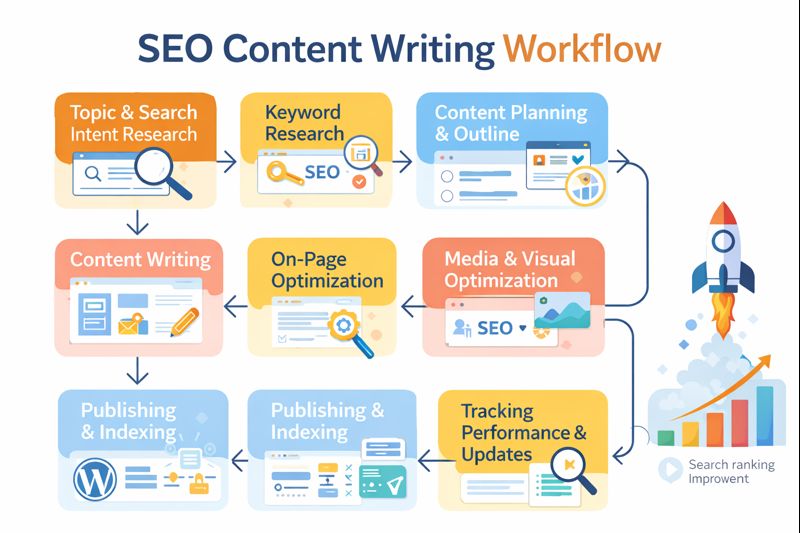
The SEO Content Writing Process: A Step-by-Step Approach
To consistently produce effective SEO content writing, follow a structured process:
- Define Your Goals: What do you want to achieve with your content? (e.g., increase leads, drive sales, build brand awareness).
- Understand Your Audience: Create detailed buyer personas.
- Conduct Thorough Keyword Research: Identify primary, secondary, and long-tail keywords.
- Analyze Competitors: See what content is ranking well for your target keywords.
- Outline Your Content: Structure your article with clear headings and subheadings.
- Write High-Quality Content: Focus on value, engagement, and readability.
- Optimize On-Page Elements: Integrate keywords naturally, optimize titles, meta descriptions, and images.
- Implement Internal Linking: Connect related content on your site.
- Edit and Proofread: Ensure flawless grammar and spelling.
- Publish and Promote: Share your content on social media and through email.
- Build Backlinks: Actively pursue high-quality external links.
- Monitor and Analyze: Track your rankings, traffic, and conversions using tools like Google Analytics.
- Update and Refresh: Keep your content evergreen by updating it regularly.
Common Pitfalls to Avoid in SEO Content Writing
Even with the best intentions, SEO content writers can fall into common traps. Be aware of these:
- Keyword Stuffing: Overusing keywords unnaturally, which harms readability and can lead to penalties.
- Thin Content: Creating content that lacks depth or doesn’t fully answer user queries.
- Ignoring Search Intent: Writing content that doesn’t match what users are actually looking for.
- Poor Readability: Walls of text without formatting make content difficult to digest.
- Lack of Originality: Relying too heavily on existing information without adding new value.
- Neglecting Mobile Optimization: With the majority of searches happening on mobile, your content must be mobile-friendly.
The Future of SEO Content Writing
The landscape of SEO content writing is constantly evolving. As search engines become more sophisticated, the focus will continue to shift towards:
- Artificial Intelligence (AI): AI tools can assist with content creation, keyword research, and optimization, but human oversight remains crucial for quality and nuance.
- User Experience (UX): Search engines are increasingly prioritizing UX signals, such as dwell time and bounce rate.
- E-E-A-T: The emphasis on demonstrating experience, expertise, authoritativeness, and trustworthiness will only grow, especially for sensitive topics.
- Voice Search: Optimizing for conversational, natural language queries will become more important.
- Video and Visual Content: Integrating video and interactive elements into your content strategy.
Staying abreast of these trends is essential for long-term success in SEO content writing.
Conclusion
Mastering SEO content writing is an ongoing journey, but the rewards are substantial. By focusing on thorough keyword research, meticulous on-page optimization, creating truly valuable content, and building your website’s authority, you can significantly enhance your search engine visibility and attract a steady stream of qualified organic traffic. Remember, the ultimate goal of SEO content writing is to serve your audience while also being discoverable by search engines. It’s a powerful combination that drives sustainable business growth.